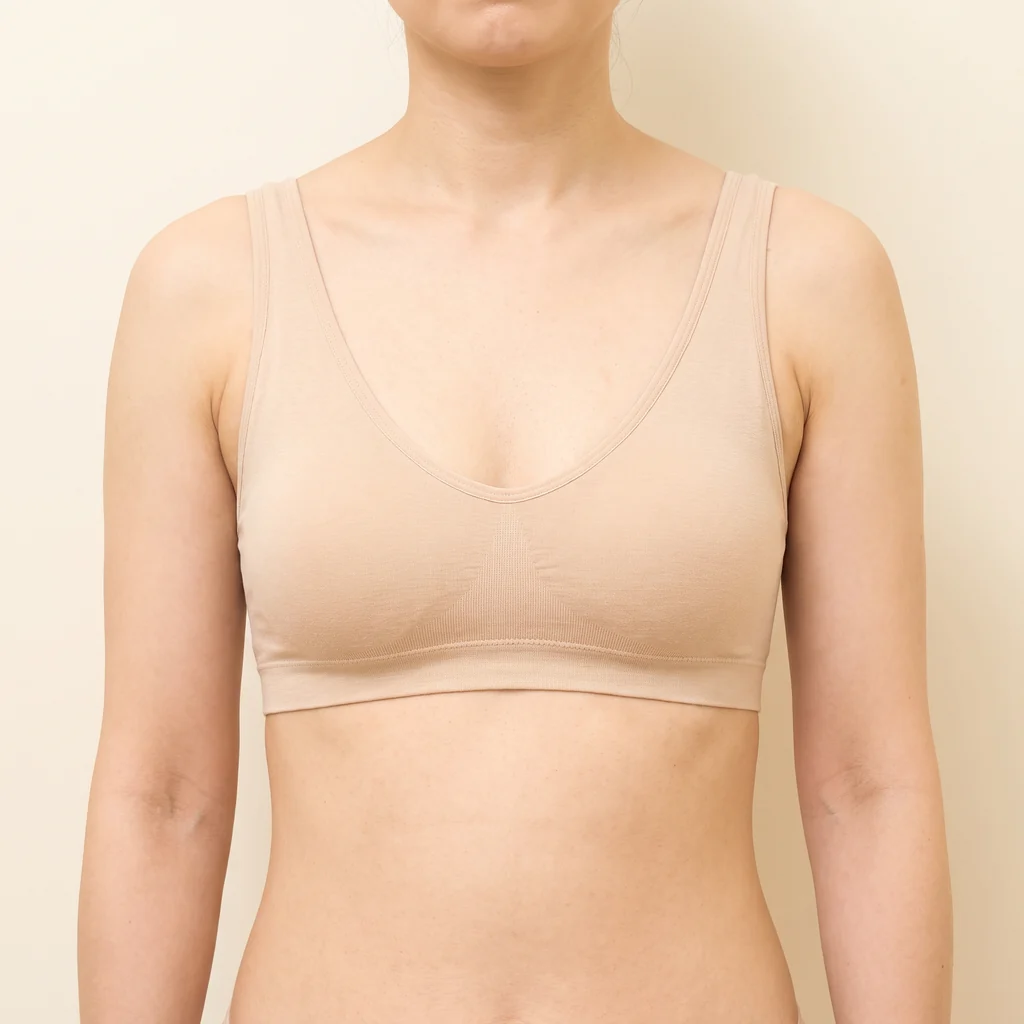
Medical description
Breast augmentation with fat transfer, or autologous fat grafting, uses the patient's own fat, harvested by liposuction from an area of excess (abdomen, hips, thighs), then purified and reinjected in fine particles into the breasts. Unlike augmentation with implants, it introduces no foreign body and gives a more moderate increase in volume, with a very natural feel. It also has the advantage of slimming the donor area. Part of the injected fat is reabsorbed in the first few months; the volume then stabilises and a second session may be offered to complete the result. This technique is also suitable for correcting an asymmetry or refining a result after implants.
What the procedure can correct
- Wish for a moderate increase in volume
- Preference not to have breast implants
- Slight asymmetry between the two breasts
- Hollows or irregularities of the cleavage
- Localised excess fat on the body
The ideal candidate
A woman in good health, at a stable weight, who has sufficient fat reserves and would like a discreet augmentation of around one cup size at most. Breasts without marked sagging and supple skin help the graft to take. A prior breast assessment is essential, and smoking must be stopped, as it compromises the survival of the fat.
The technique
Under general anaesthesia, the fat is first harvested with fine cannulas through small incisions hidden in the natural folds. It is then purified by decantation, centrifugation or filtration, and reinjected into the breasts through multiple tunnels and at different depths, to encourage revascularisation. The incisions measure a few millimetres. A compression garment is worn over the donor areas and a soft, non-compressive bra on the breasts.
Your stay, step by step
- 1
Arrival and consultation
Welcome by your coordinator, examination and pre-operative consultation with the practitioner, who confirms the treatment plan.
- 2
Procedure
General · 2–3 h
- 3
Monitoring in the clinic
Hospital stay: 1 night. The care team looks after your comfort and post-operative monitoring.
- 4
Check-up before departure
Follow-up visit, care, instructions and prescription before your flight home. Recommended stay: 7–8 days.
- 5
Remote follow-up
Back home, you send your photos and stay in touch with the practitioner through your patient area, for up to 12 months.
Risks and recovery
The usual after-effects are mainly related to the liposuction: bruising, swelling and aching in the donor areas, with breasts that are tender and swollen at first. Possible complications include partial reabsorption of the fat, asymmetry, infection, and the formation of oil cysts, fat necrosis nodules or microcalcifications, which should be mentioned at subsequent breast examinations. Your surgeon will explain these in detail during the consultation.
The information on this page is provided for guidance only and does not replace a medical consultation. Every procedure carries risks; the indication is made by the practitioner after examination, and results vary from person to person.
Frequently asked questions
Is the volume achieved stable over time?
Part of the fat is reabsorbed during the first few months. The fat that has survived then behaves like living tissue and may vary with your weight.
Does fat transfer interfere with breast screening?
It can leave visible findings on mammography or ultrasound, which radiologists are generally able to interpret. It is important to mention the procedure at every screening examination.
Can a large increase in volume be achieved in a single session?
No, the gain per session remains moderate, as the fat needs a good blood supply to survive. For a larger augmentation, your surgeon may suggest several sessions or a technique combining an implant with fat transfer.