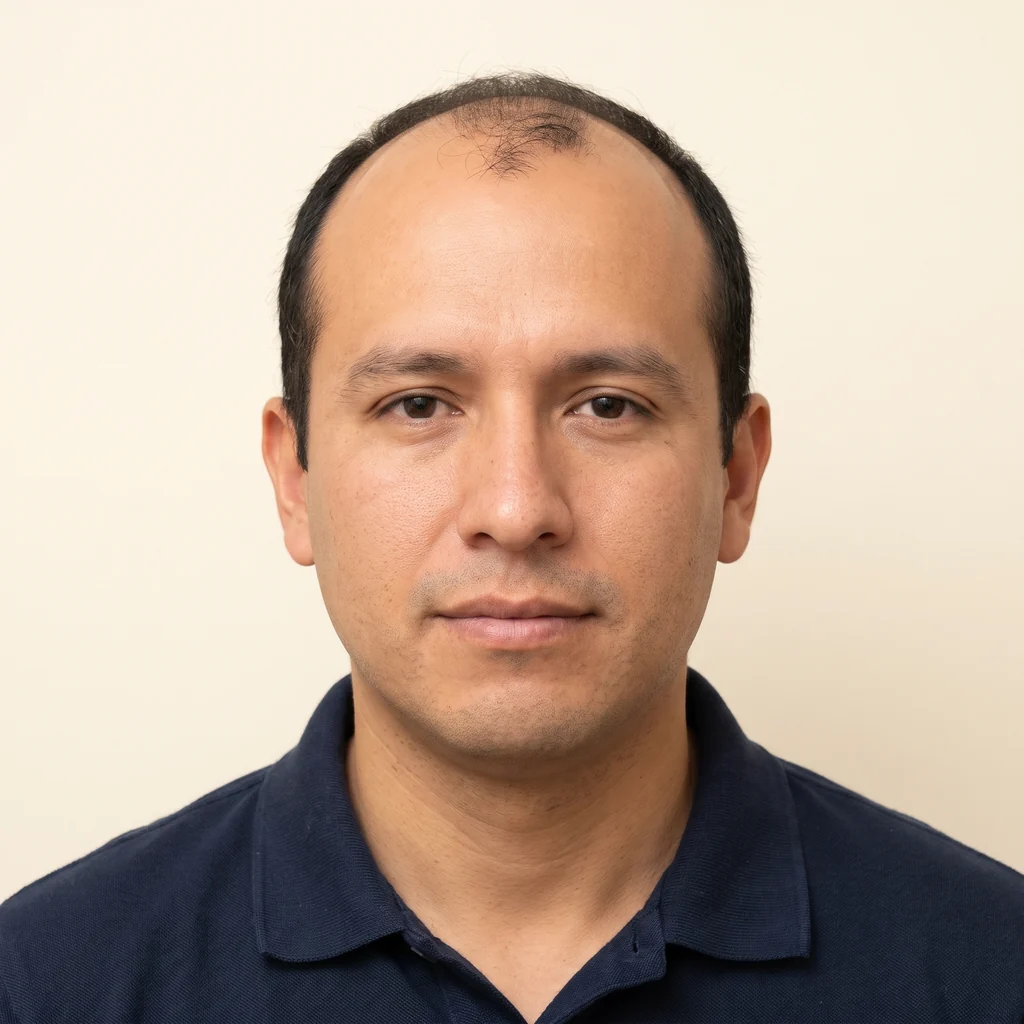
Medical description
Sapphire FUE follows the principle of FUE: the follicular units are harvested one by one from the donor area and then implanted into the thinning areas. What sets it apart is the instrument used to open the recipient channels: sapphire micro-blades, finer and smoother than steel blades. They allow clean, small and precisely oriented incisions, which may reduce trauma to the scalp, promote faster healing and make dense implantation easier. Unlike DHI, the channels are opened before the grafts are placed with forceps. The harvesting and the limits of the donor area remain the same; the indication is confirmed by the doctor after examination.
What the procedure can correct
- Receding temples and hairline
- Baldness on the crown
- Extensive loss of density on top of the head
- Need for dense, even implantation
- Wish for more discreet skin after-effects
The ideal candidate
A person with stabilised hair loss, a good-quality donor area, and a wish to cover a medium to large area with dense implantation. In young patients or those whose hair loss is progressing, medical treatment for hair loss may be offered in addition. Expectations must take into account the limited number of grafts available over a lifetime.
The technique
The donor area is shaved and the follicular units are harvested using a micro-punch, then sorted and stored in a suitable solution. The doctor then opens the recipient channels with sapphire blades, the size of which is chosen according to that of the grafts, respecting the natural angle and direction of the hair, then implants the grafts one by one with forceps. The procedure is performed under local anaesthesia. A bandage is applied to the donor area.
Your stay, step by step
- 1
Arrival and consultation
Welcome by your coordinator, examination and pre-operative consultation with the practitioner, who confirms the treatment plan.
- 2
Procedure
Local · 6–8 h
- 3
Back to the hotel
Day-case treatment: you return to your hotel the same day, accompanied.
- 4
Check-up before departure
Follow-up visit, care, instructions and prescription before your flight home. Recommended stay: 3–4 days.
- 5
Remote follow-up
Back home, you send your photos and stay in touch with the practitioner through your patient area, for up to 12 months.
Risks and recovery
The usual after-effects include temporary swelling of the forehead, small scabs, redness and tenderness of the donor area, sometimes more discreet thanks to the fineness of the incisions, although this is not always the case. As with any transplant, the transplanted hairs fall out temporarily in the following weeks (shock loss) before growing back. Folliculitis, infection, numbness, lower density than expected or a sparse appearance of the donor area if overharvested may occur. Your surgeon will explain these in detail during the consultation.
The information on this page is provided for guidance only and does not replace a medical consultation. Every procedure carries risks; the indication is made by the practitioner after examination, and results vary from person to person.
Frequently asked questions
Does the sapphire blade change the final result?
The density and final appearance depend mainly on the donor area, the number of grafts and the quality of the implantation. The sapphire blade mainly affects the fineness of the incisions and may help healing.
How many transplants can be done over a lifetime?
The donor area does not regenerate: the number of grafts that can be harvested is limited. A second session is sometimes possible, depending on the remaining reserves, hence the value of long-term planning.
Should I avoid the sun after the transplant?
It is recommended to protect the scalp from direct sun for several weeks, for example with a loose-fitting hat approved by the doctor. This precaution limits redness and pigmentation problems.