Medical description
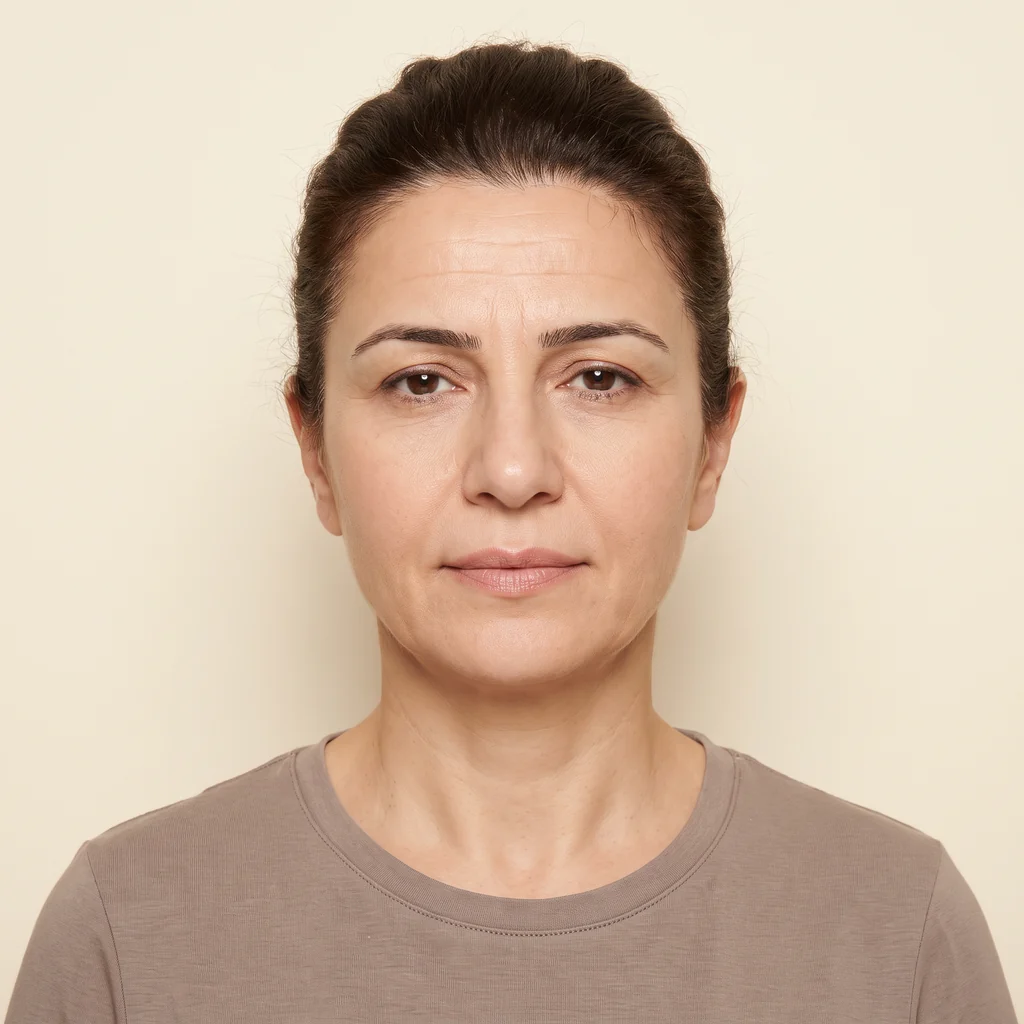
The brow lift, or forehead lift, corrects drooping eyebrows and a sagging forehead. Over time, the tail of the eyebrow descends, weighs down the upper eyelid and gives the eyes a sad or stern look; horizontal forehead lines and frown lines may also be present. The procedure repositions the eyebrows at a more harmonious height and can soften certain lines by weakening the muscles responsible. It differs from upper blepharoplasty, which treats excess eyelid skin: indeed, the two procedures are often complementary.
What the procedure can correct
- Drooping eyebrows, especially at the outer end
- Sad or stern-looking eyes
- Heaviness of the upper eyelid caused by the brow
- Horizontal forehead lines
- Frown lines between the eyebrows
The ideal candidate
A person with genuine brow ptosis confirmed on examination, in good health and without unrealistic expectations. The height of the hairline and the shape of the forehead guide the choice of technique. Smoking must be stopped, and any previous eyelid surgery should be mentioned.
The technique
The procedure is performed under general anaesthesia or sedation. The endoscopic approach uses a few small incisions hidden in the scalp, through which the surgeon releases the forehead tissues and secures the eyebrows higher up. Depending on the anatomy, the surgeon may prefer an incision at the hairline, a temporal approach limited to the tail of the brow, or an approach through the upper eyelid. A dressing or headband is applied for one to two days.
Your stay, step by step
- 1
Arrival and consultation
Welcome by your coordinator, examination and pre-operative consultation with the practitioner, who confirms the treatment plan.
- 2
Procedure
General, or local with sedation · 1–2 h
- 3
Monitoring in the clinic
Hospital stay: Day case or 1 night. The care team looks after your comfort and post-operative monitoring.
- 4
Check-up before departure
Follow-up visit, care, instructions and prescription before your flight home. Recommended stay: 7–8 days.
- 5
Remote follow-up
Back home, you send your photos and stay in touch with the practitioner through your patient area, for up to 12 months.
Risks and recovery
Swelling of the forehead and eyelids, bruising and numbness of the scalp are usual and gradually subside. Less commonly: haematoma, infection, asymmetry of the eyebrows, excessive elevation, localised hair loss at the scars or temporary injury to the frontal nerve. Your surgeon will explain these in detail during the consultation.
The information on this page is provided for guidance only and does not replace a medical consultation. Every procedure carries risks; the indication is made by the practitioner after examination, and results vary from person to person.
Frequently asked questions
Will my expression change?
The aim is to restore a natural position to the eyebrows, without a surprised look. Your surgeon will assess with you the height and curve that suit your face.
Are the scars visible?
With the endoscopic approach, the incisions are small and hidden in the hair. The other approaches leave a scar at the hairline or in the eyelid crease, which is generally discreet.
Do I also need an eyelid lift?
Not always: if the heaviness of the eyes comes mainly from the brow, a brow lift alone may be enough. If there is also excess skin, the two procedures are often performed together.